 ultimate-guide
Strata Defect Rectification Process in Sydney: A Step-by-Step Guide
Last Updated: November 5, 2026
Quick Summary
Strata defect rectification is the process of identifying faults in common property or lots, documenting them, establishing their root causes, and then scoping, tendering and funding the repair. Owners should start early, since NSW bond scheme inspection deadlines run from the occupation certificate date.
- Identify defects early, because the cost to fix them tends to rise the longer they are left.
- Document each defect with dated, wide and close-up photographs and keep the original files.
- Commission an independent strata defect inspection report before requesting any builder tenders.
- For eligible NSW buildings, the 12-month and 24-month statutory inspection deadlines run from the occupation certificate.
- Ask each tenderer to break the price into labour, materials, access, contingency and provisional sums.
Table of Contents
- What Strata Building Defects Are and How to Identify Them
- How to Document Strata Building Defects
- Commissioning a Strata Defect Inspection Report
- The NSW Building Bond and Inspection Scheme Explained
- Who Is Responsible for Fixing Defects and Choosing a Pathway
- Diagnosing Root Causes, Scoping Works and Obtaining Tenders
- Strata Defect Rectification Timeline and Cost Control
- Booking Your First Scoping Inspection With Marvel Concept Build
- Frequently Asked Questions
What Strata Building Defects Are and How to Identify Them
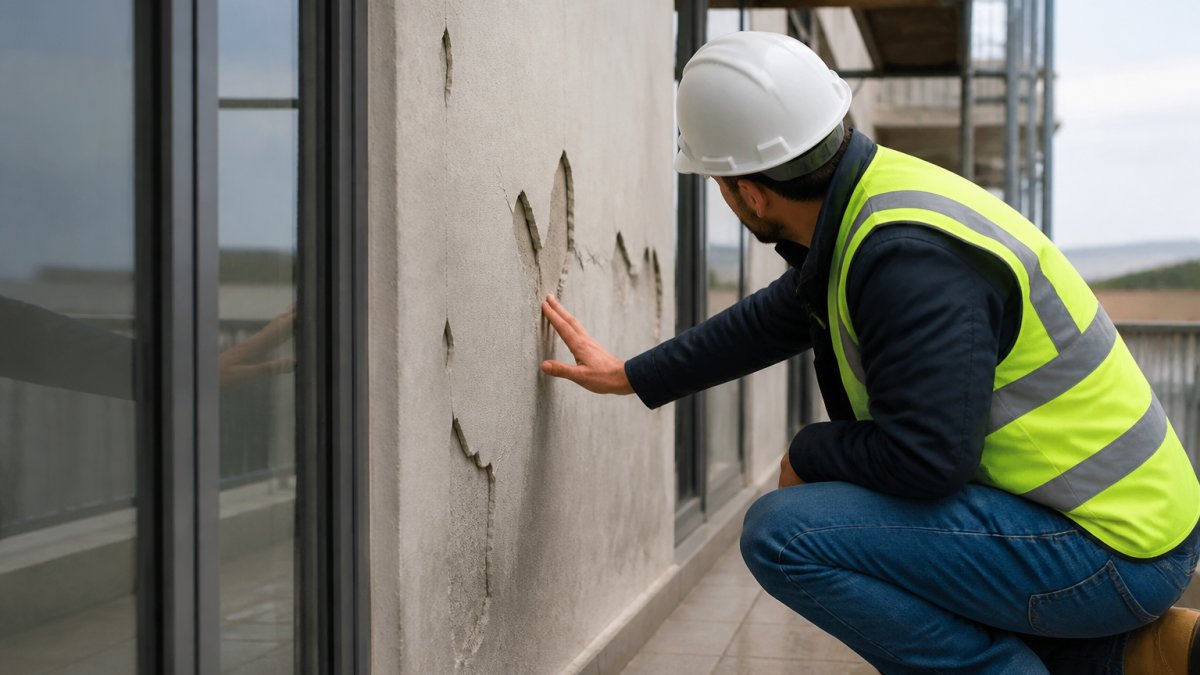
Strata building defects are faults in the construction or ongoing condition of common property and lots within a strata scheme that fall short of the standard the building was meant to meet, and identifying them early is the first step in any strata defect rectification process.
A visible symptom often has a hidden cause somewhere else in the building. A damp ceiling in a unit can be a balcony membrane failure two floors up, which is why identification needs to look at the whole building, not just the symptom.
Structural, waterproofing, fire-safety and services defects
Structural defects affect the load-bearing elements of the building, such as slabs, columns, beams and footings.
Waterproofing defects are the most common category in Sydney apartment buildings. Look for efflorescence, blistering paint, soft plaster near wet areas and staining on the underside of balconies.
Fire-safety defects include missing or damaged fire-rated penetrations, compromised fire doors and non-compliant smoke detection.
Services defects cover plumbing, drainage, electrical and mechanical systems serving common property. Recurring blockages, pressure loss across floors and tripping circuits in shared areas are common indicators.
How to Document Strata Building Defects
Good documentation is what turns a complaint into a defect that can be formally scoped, costed and rectified. Without it, owners corporations often struggle to establish when a problem began or who is responsible for it.
Photographs, dates and supporting evidence to collect
Take wide shots that establish location, followed by close-ups that show the defect clearly. Include a common reference point, such as a door frame or floor level, so the scale is obvious. Record the date and time on every photograph and keep the original files rather than screenshots.
Keep a dated log of every observation, including who reported it, to whom, and any response received. Collect maintenance records, previous inspection reports, plans and correspondence with the developer or builder. Where water ingress is suspected, note the weather conditions on the day the stain appeared.
Commissioning a Strata Defect Inspection Report
A strata defect inspection report sets out, in writing, what was found, where, how severe it is and what is recommended. It is the document the owners corporation will rely on when deciding what to rectify and who should pay.
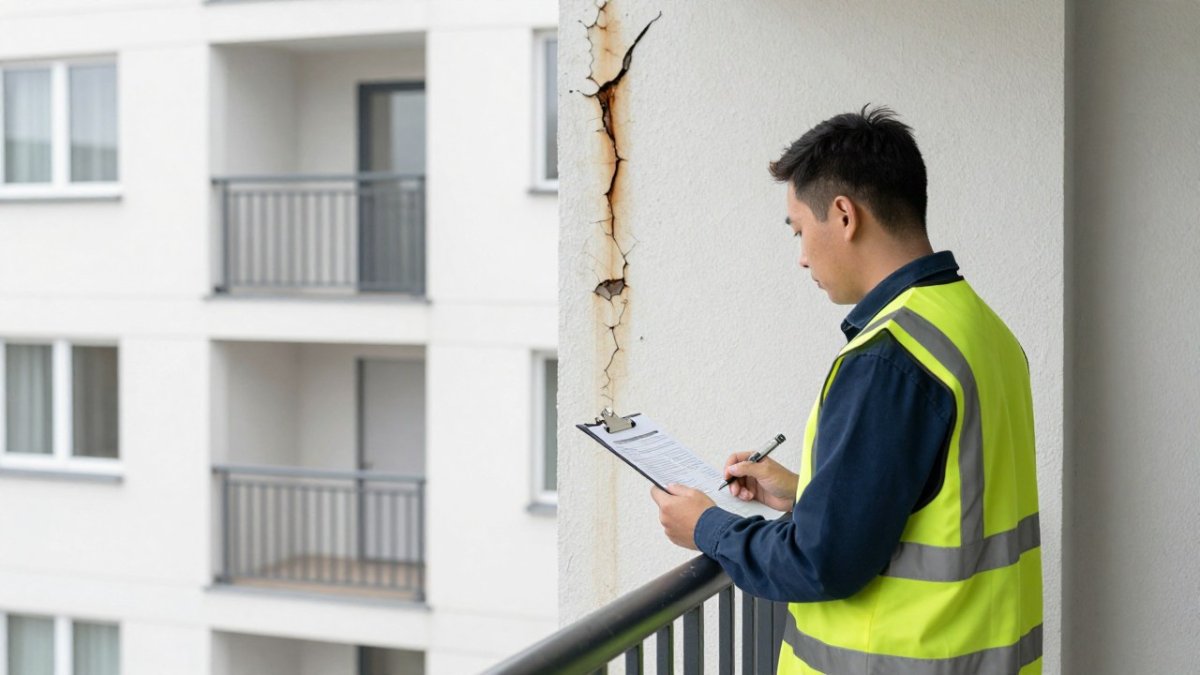
When you commission an inspection, engage a suitably qualified and independent inspector rather than a contractor who would then be pricing their own work. Before requesting tenders afterwards, review what a builder quote should include so the figures can be compared on the same basis.
The NSW Building Bond and Inspection Scheme Explained
New South Wales operates a statutory building bond and inspection regime for certain residential apartment buildings, and the rules are strict enough that a committee needs to know the key dates before it does anything else. The scheme sits alongside, not instead of, the common-law and contractual remedies an owners corporation may have against a developer or builder, so understanding how the pieces fit together prevents wasted time and legal costs.
Which buildings are covered
The regime applies to residential apartment buildings that are at least four storeys high and contain two or more residential lots, where the building work was carried out under a construction contract entered into on or after 1 July 2018. Mixed-use buildings can be caught where the residential component meets those thresholds. Smaller schemes, townhouse developments and buildings contracted before that date fall outside the bond scheme and must rely on other pathways, including the statutory warranty provisions in the Home Building Act 1989 (NSW) and any contract terms.
The 2% building bond
For eligible buildings, the developer must lodge a building bond with NSW Fair Trading equal to 2% of the contract price for the building work. The bond is security for the cost of fixing defective work identified through the statutory inspection process. It is not a general maintenance fund and it is not released to the owners corporation automatically, it is drawn down only through the process set out in the legislation.
Statutory inspection deadlines
The scheme runs on fixed milestones measured from the date the occupation certificate is issued:
- 12 months after the occupation certificate, the developer must arrange the first statutory inspection of the building work (the interim inspection).
- 24 months after the occupation certificate, the developer must arrange the second statutory inspection (the final inspection).
A strata inspector appointed by the developer, and approved by NSW Fair Trading, carries out each inspection and prepares a report identifying defective work and whether it is a serious defect. The owners corporation is notified and has an opportunity to make submissions before the report is finalised. The Secretary of the Department of Customer Service (through NSW Fair Trading) then decides whether rectification is required and whether the bond, or part of it, should be released to fund the work.
What counts as a serious defect
The legislation distinguishes serious defects from other defective work. Serious defects generally include defects that affect the structural integrity of the building, cause or are likely to cause water penetration, affect the fire safety of the building, or otherwise render the building unsafe or uninhabitable. The classification matters because it drives the rectification order, the timeframe for the developer to act, and the owners corporation's ability to access the bond if the developer does not comply.
What the owners corporation must do
The committee's job is to be ready. That means keeping a dated defect log from day one, commissioning an independent defects report before each statutory inspection so the owners' evidence is organised, and making a written submission to the inspector within the timeframe notified.
Watch out: the 12-month and 24-month clocks run from the occupation certificate, not from settlement or from when the owners corporation first notices a problem. A committee that waits for a defect to become obvious can miss the window entirely.
Where the bond scheme does not apply
If the building falls outside the scheme, for example, because the construction contract predates 1 July 2018 or the building is under four storeys, the owners corporation is not without options. Owners corporations can pursue the developer, builder or other responsible parties through the statutory warranty provisions under the Home Building Act 1989 (NSW), subject to the time limits in that Act, using the available dispute resolution processes. Confirm the current warranty periods and forums with NSW Fair Trading or a qualified legal adviser. Strata insurance may also respond to certain events, so check the policy wording before assuming a defect is uninsured.
Who Is Responsible for Fixing Defects and Choosing a Pathway
Responsibility depends on who built the defect, when it was identified and what protections apply. Owners weighing who pays can check whether strata insurance covers defect rectification before choosing a pathway. Responsibility can sit with the developer, the builder, a consultant, or the owners corporation itself for common property maintenance.
Broadly, owners usually choose between a negotiated resolution with the developer or builder, a formal claim through the available statutory pathways, or the owners corporation funding and managing the works directly.
Diagnosing Root Causes, Scoping Works and Obtaining Tenders
Fixing a symptom without finding its cause is the most expensive mistake in defect rectification.
A common mistake is to tender for a repair before the root cause is confirmed. A contractor who patches a balcony leak without identifying the failed membrane will likely be back within a year.
When obtaining tenders, ask each contractor to price against the same written scope so the figures can be compared fairly. It also helps to know what communication to expect from a builder while works are scoped and managed.
Contract transparency matters here. For practical guidance on contract transparency when comparing custom build contracts, review the key clauses before committing.
Strata Defect Rectification Timeline and Cost Control
Rectification timelines and costs are the two questions every committee asks first. Both are driven by the defect type, the building's age and the evidence available. What a committee can control is how the work is scoped, funded and monitored, and that is where the real savings sit.
What actually drives the timeline
A realistic program usually has five phases, and each has its own dependencies:
- Investigation and diagnosis, longer where specialist testing such as moisture mapping, concrete testing or fire engineering assessment is required.
- Scope and tender, longer for complex or whole-of-building works where multiple trades are involved.
- Approvals and procurement, including any development approval, strata committee resolution, or building-certifier involvement.
- Construction, the largest variable. Curing, weather and access windows all add time.
- Verification and sign-off, including follow-up inspection, defect correction and handover documentation.
Committees often underestimate the investigation and verification phases. Building in float at each stage is more realistic than assuming a single completion date.
What drives the cost
The biggest cost drivers are access (scaffolding, swing stages, roof anchors), the extent of removal and make-good work, the standard of finish specified, the number of separate trades, and whether the work is done while the building is occupied.
Rather than quote a single figure, ask each tenderer to break the price into labour, materials, access, contingency and provisional sums. That breakdown is what lets a committee compare like-for-like and spot the tender that has excluded the expensive parts.
Funding the works
Most owners corporations fund rectification through one or more of the following:
- Special levies, a one-off levy on owners, usually the fastest route but the hardest for owners on fixed incomes.
- Administrative fund and capital works fund, drawing down existing reserves, which may require a sinking fund plan update.
- Strata loans, some lenders offer finance to owners corporations for major works, repaid through levies over an agreed term.
- Insurance proceeds, where the defect arises from an insured event, though wear-and-tear and defective workmanship are commonly excluded.
- Statutory bond or developer-funded rectification, where the building bond scheme or a warranty claim applies, as covered above.
A practical approach is to model the total cost, decide how much can come from reserves without compromising the capital works plan, and then set the special levy or loan over a period owners can absorb. The committee should document the resolution and the reasons for the funding choice, because owners are entitled to understand how the decision was made.
Cost-control measures that work
- Set a contingency of a realistic percentage of the contract value, most practitioners allow for variations and latent conditions rather than assuming the tender price is final.
- Tie payments to verified milestones, not to calendar dates, and withhold a retention until the defect liability period has run.
- Agree a variation process in advance, who can approve, at what threshold, and with what documentation.
- Require progress reporting against the program so slippage is visible early rather than at handover.
- Commission an independent review of the scope and tender evaluation where the value is significant, to reduce the risk of a scope gap being discovered mid-project.
Watch out: the cheapest tender is frequently the one with the most exclusions. Compare the scope line by line, not just the bottom line, and ask each tenderer to confirm what is excluded in writing.
Keeping residents informed
Cost control and resident relations are linked. Planned access notices, agreed noise windows, temporary safety measures and regular progress updates reduce complaints and reduce the pressure on the committee to approve variations just to keep the peace. A short written update after each site meeting is usually enough to keep owners onside and to create a record if the project is later questioned.
The article sets out the main drivers of cost and timing in a rectification project, summarised below.
| Item | Value | Note |
|---|---|---|
| Typical phases | 5 | Investigation, scope and tender, approvals, construction, verification |
| Biggest timeline variable | Construction | Curing, weather and access windows add time |
| Commonly underestimated | Investigation and verification | Build float into each stage |
| Main cost drivers | Access and make-good | Scaffolding, removal and finish standard |
| Waterproofing cost | Often higher than expected | Membrane removal and substrate repair |
| Tender comparison | Labour, materials, access, contingency | Ask for a price breakdown |
| Cheapest tender risk | Most exclusions | Compare scope line by line |
Booking Your First Scoping Inspection With Marvel Concept Build
If your owners corporation is dealing with suspected defects, the most useful first step is a scoping inspection that identifies the defects, their likely causes and what the rectification pathway should look like. At Marvel Concept Build Pty Ltd, we hold NSW Builder's Licence 468998C, carry $20M public liability cover, and provide a dedicated point of contact, weekly progress updates and a stage-by-stage quality sign-off on every project.
Frequently Asked Questions
What is the strata defect rectification process?
The process usually runs in stages: identifying and documenting defects, obtaining an independent inspection report, deciding who is responsible, scoping the works, tendering to qualified contractors, carrying out the repairs and confirming completion with sign-off and follow-up inspections. Each stage produces records that the owners corporation relies on later, so keeping dated evidence throughout is essential.
How should an owners corporation report a building defect?
Report the defect in writing to the builder or developer as early as possible, describing the location, the symptoms and when they were first noticed. Attach dated photographs and any inspection findings. Keep copies of every notice and response. Where the builder does not respond, the owners corporation can escalate through NSW Fair Trading or the appropriate tribunal, and a clear written record strengthens that position.
How does the NSW building bond and inspection scheme work?
Under the NSW building bond and inspection scheme, a portion of the builder's contract price may be held as security for defects that appear after completion. Owners corporations should check whether a bond applies to their building, the deadlines for making a claim, and the inspection requirements. Confirm current eligibility rules with NSW Fair Trading, as timeframes and conditions can change.
Who is responsible for fixing defects in a strata building?
Responsibility depends on the defect type, the age of the building and the contracts and warranties in place. Structural and waterproofing defects in common property are generally the concern of the owners corporation, which may pursue the developer or builder under statutory warranties. Individual lot defects usually fall to the lot owner. An independent inspection is the most reliable way to establish which party is responsible.
How long can strata defect rectification take?
Timelines vary widely. A minor repair may take a few weeks, while structural or waterproofing works across a whole building can take many months once scoping, tendering, approvals and staged construction are included. Build in time for contractor availability, weather and resident access, and ask any contractor for a written programme with milestones.
Can an owners corporation claim insurance for building defects?
Standard building insurance generally does not cover defects caused by poor workmanship or design, but it may respond to resulting damage from an insured event. Owners corporations should review their policy wording with their broker and notify the insurer promptly. Documented evidence from the inspection process is important for any claim.
What should owners do if a builder does not rectify a defect?
Send a formal written notice setting out the defect and a reasonable deadline for rectification. If the builder fails to act, owners corporations can seek assistance from NSW Fair Trading, use any available building bond, or apply to the NSW Civil and Administrative Tribunal. Legal advice is recommended before commencing proceedings, particularly where limitation periods may apply.
What evidence should be collected before strata defect repairs begin?
Collect dated photographs and video of each defect from several angles, the original plans and specifications, the inspection report, correspondence with the builder or developer, maintenance records and any prior repair invoices. This evidence supports the scope of works, the tender process and any later dispute, and it provides a baseline for verifying completion.
Start Your Project with Marvel Concept Build Pty Ltd, and let us help your owners corporation move from identifying defects to a verified, well-documented repair.