 ultimate-guide
Does Strata Insurance Cover Defect Rectification?
Last Updated: October 28, 2026
Quick Summary
Strata insurance generally does not cover the cost of rectifying a strata defect itself, because most policies exclude defective workmanship, faulty design and materials. It may cover resulting damage, such as water escaping a failed membrane and damaging the ceiling below, subject to the policy wording and excesses.
- Water ingress is the most common defect category reaching insurers, usually from failed membranes or poor drainage.
- Many policies apply a standard excess plus a separate water-damage excess, and some depreciate damaged materials.
- Notify the insurer as soon as the loss is identified, not after the defect report is finished.
- A defect report must establish what the defect is, its cause, and what proper rectification will take.
- Get advice early on builder claims, as time limits apply and warranty periods can lapse.
Table of Contents
- What Counts as a Strata Defect (and What Insurers Actually Cover)
- Maintenance Versus Insurance in Strata: Where the Line Sits
- How Defects Interact With Strata Insurance Exclusions and Excesses
- What a Strata Building Defect Inspection Report Must Establish
- The Owners Corporation Insurance Claim Process, Step by Step
- A Strata Building Defect Evidence Checklist for Committees
- Who Is Liable: Builders, Developers, or the Owners Corporation?
- When a Claim Is Declined: Dispute and Review Pathways
- Booking a Defect Rectification Assessment
- Frequently Asked Questions
What Counts as a Strata Defect (and What Insurers Actually Cover)
A strata defect is a fault in a building's common property that causes it to fall short of the standard it was designed or built to meet. Strata defect rectification insurance claims begin with one hard question: is this a building failure the policy responds to, or a maintenance obligation the owners corporation must fund itself?
Here is the part most committees get wrong. They assume a defect automatically triggers a payout. It doesn't. Strata insurance is written to cover sudden, accidental damage to the building, not the cost of putting right poor workmanship or a design flaw that was always there. At Marvel Concept Build Pty Ltd, we've sat in enough committee meetings to know that gap causes more frustration than any other issue in strata.
The distinction matters because the two problems look identical on a wall. A cracked render and a cracked render from a failed waterproof membrane present the same way. The cause, not the appearance, decides who pays.
Defect Types That Drive Claims
Defects that reach insurers cluster into a handful of recognisable categories. Water ingress is the most common, usually traced to failed membranes, blocked or inadequate drainage, or poorly sealed penetrations. Structural defects come next: cracking in load-bearing elements, slab movement, and inadequate tie-down. Fire-safety defects sit in a category of their own because they carry legal obligations on top of repair costs, and owners corporations cannot defer them.
Then there is defective workmanship that produces no immediate damage at all, such as tiles laid without fall to a waste outlet. It is a defect. It will cause damage. But until it does, most policies have nothing to respond to.
Maintenance Versus Insurance in Strata: Where the Line Sits
The dividing line is cause. Maintenance versus insurance in strata comes down to whether the damage was sudden and unforeseen or the predictable result of wear, age, or a known fault left unrepaired.
Insurers read policy wording closely here. A failed sealant that has been visibly degrading for years is a maintenance item. A pipe that bursts without warning is a claim. The same water ends up on the same carpet, but the response is completely different.
A common mistake is treating a defect report as an insurance claim. They serve different purposes. The report establishes what is wrong and why; the claim asks the insurer to fund a specific loss. Committees that conflate the two often notify insurers too late or with the wrong framing, which gives the insurer grounds to question the claim.
If you are coming from a body corporate background interstate, expect the terminology to shift, but the principle holds: the owners corporation carries the maintenance duty, and insurance steps in only for the events the policy names.
How Defects Interact With Strata Insurance Exclusions and Excesses
Exclusions do most of the work in a strata policy, and defective workmanship sits near the top of the list. Most policies exclude the cost of rectifying the defect itself, along with the cost of making good faulty design or materials. What they may still cover is the resulting damage, and even then, only where the damage is a defined event the policy responds to.
The distinction that decides most claims is between the defective work itself and the damage it causes. A failed waterproof membrane in a bathroom is the defect. The water that escapes and damages the ceiling of the unit below is the resulting damage. Most policies will not pay to replace the membrane, because that is rectifying defective work. They may pay to repair the damaged ceiling, subject to the policy wording, the excess, and whether the damage was sudden and accidental.
Excesses compound the problem in ways committees rarely anticipate. Many strata policies apply a standard excess plus a separate water-damage excess, and some apply age-based depreciation to damaged materials such as carpet, timber flooring, or cabinetry. A claim that looks straightforward on paper can return far less than the committee expected. Before authorising any repair, read the policy schedule and the excess section line by line, and ask the broker to confirm in writing which excesses apply to the specific event.
Policy wording varies materially between insurers. Some policies extend cover to accidental damage caused by defective workmanship where the damage is not to the defective work itself; others exclude it entirely. The only reliable answer is the product disclosure statement and policy schedule for the specific policy, read alongside advice from a broker who places strata risks. Where the wording is ambiguous, ask the insurer to confirm coverage in writing before work begins, a written position is far easier to rely on than a verbal assurance.
What a Strata Building Defect Inspection Report Must Establish
A strata building defect inspection report must establish three things: what the defect is, what caused it, and what it will take to rectify it properly. Without all three, the report is a list of symptoms, not evidence.
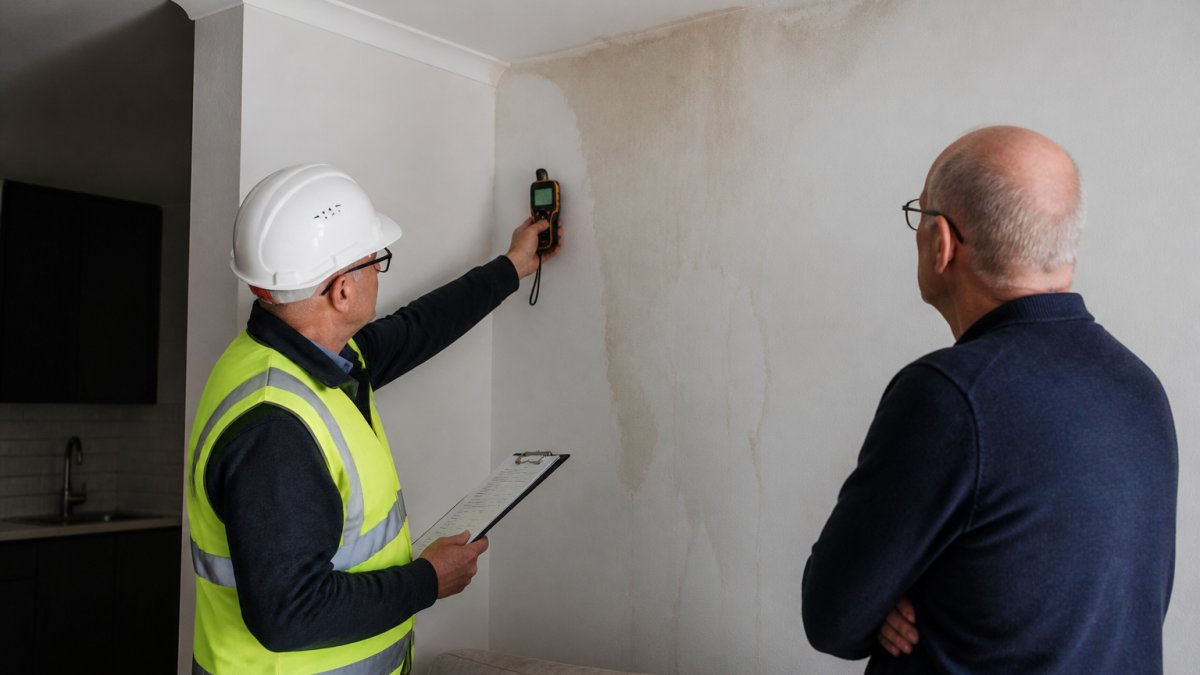
The cause is the part insurers scrutinise hardest, because it determines whether the loss falls inside or outside the policy. A report that says "water damage to unit 4 ceiling" tells the insurer nothing. A report that identifies a failed shower membrane in the unit above, with moisture readings and photographs, gives them something to assess.
The report should also separate localised defects from building-wide programmes, because a single failed membrane and a systemic waterproofing failure across a facade are entirely different claims and different rectification projects.
The Owners Corporation Insurance Claim Process, Step by Step
The owners corporation insurance claim process follows a sequence, and skipping a step is the fastest way to a declined claim.
- Secure the site and mitigate further damage. Stop the water, make safe, and document what you did. Insurers expect damage mitigation and may reduce a payout where it was neglected.
- Notify the insurer promptly. Claim notification should happen as soon as the loss is identified, not after the report is finished. Late notification is a common reason claims are questioned.
- Commission an independent defect assessment. Get the cause established by someone qualified, with photographs, moisture readings, and a cost estimate.
- Gather the evidence pack. Policy schedule, committee minutes authorising the claim, the defect report, quotes, and your mitigation records.
- Lodge the claim with a clear statement of the loss. Separate the insured event from the underlying defect in your wording.
- Respond to the assessor. Insurers will send their own assessor. Attend, and have your consultant available.
- Await the outcome and coordinate repairs. Once approved, sequence urgent repairs first and keep the insurer informed of progress.
Expected result: a documented, defensible claim file that an assessor can work through without coming back to the committee for basics.
A Strata Building Defect Evidence Checklist for Committees
A strata building defect evidence checklist saves committees from the most common failure: a genuine claim undermined by thin documentation. Work through it before you lodge.
- Policy schedule and current certificate of currency
- Dated photographs of the damage, with location noted
- Independent defect report naming the cause, not just the symptom
- Moisture readings or test results where water is involved
- Committee resolution authorising the claim
- Records of damage mitigation and urgent repairs already done
- At least two itemised cost estimates for the rectification
- Maintenance history showing the item was not knowingly neglected
- Correspondence log with the insurer, dated
- Written confirmation of who is the nominated contact for the claim
That last item matters more than it looks.
Who Is Liable: Builders, Developers, or the Owners Corporation?
Liability turns on when the defect arose and who was responsible for the work. The developer carries obligations for the original construction. The owners corporation carries the maintenance duty for common property once the building is in use.
Where a claim against a builder is contemplated, get advice early. Time limits apply, and tribunal proceedings have their own thresholds and processes. Do not let a warranty period lapse while waiting on an insurer's decision.
The Jurisdictional Comparison Most Guides Skip
Most articles treat statutory warranties as a single national concept. They are not. Each state and territory has its own warranty periods, regulator, and dispute forum, and the differences decide whether a claim is viable. The table below summarises the main regimes; always confirm the current position with the relevant regulator before relying on it.
| Jurisdiction | Key regulator | Statutory warranty framework | Typical dispute forum |
|---|---|---|---|
| New South Wales | NSW Fair Trading; Building Commission NSW | Home Building Act 1989 (NSW), statutory warranties, with major defect periods running longer than general defect periods | NSW Civil and Administrative Tribunal (NCAT) |
| Victoria | Victorian Building Authority; Consumer Affairs Victoria | Domestic Building Contracts Act 1995 (Vic), implied warranties | Victorian Civil and Administrative Tribunal (VCAT) |
| Queensland | Queensland Building and Construction Commission (QBCC) | Queensland Building and Construction Commission Act 1991 (Qld), statutory insurance scheme and defect liability periods | Queensland Civil and Administrative Tribunal (QCAT) |
| Western Australia | Building and Energy (Department of Mines, Industry Regulation and Safety) | Home Building Contracts Act 1991 (WA), implied warranties | State Administrative Tribunal (SAT) |
| South Australia | Consumer and Business Services | Building Work Contractors Act 1995 (SA), statutory warranties | South Australian Civil and Administrative Tribunal (SACAT) |
| Tasmania | Consumer, Building and Occupational Services | Residential Building Work Contracts and Dispute Resolution Act 2016 (Tas) | Tasmanian Civil and Administrative Tribunal (TASCAT) |
| Australian Capital Territory | Access Canberra | Building Act 2004 (ACT), statutory warranties | ACT Civil and Administrative Tribunal (ACAT) |
| Northern Territory | Building Advisory Service | Building Act 1993 (NT), statutory warranties | Northern Territory Civil and Administrative Tribunal (NTCAT) |
Where a claim against a builder is contemplated, get advice early. Time limits apply, and tribunal proceedings have their own thresholds and processes. Do not let a warranty period lapse while waiting on an insurer's decision.
When a Claim Is Declined: Dispute and Review Pathways
A declined claim is not always the end. If the decline rests on a factual dispute about cause, a stronger expert report may resolve it through internal review. If it rests on policy interpretation, the dispute is about wording, and that is a different argument.
Keep every letter and every assessor's report; a review is only as strong as the paper trail behind it.
Booking a Defect Rectification Assessment
Rectification is a construction project with a legal file attached, and it deserves the same discipline.
This is where Marvel Concept Build Pty Ltd works. We hold NSW Builder's Licence 468998C, carry $20M public liability cover and active icare workers compensation, and we specialise in strata defect rectification. Every project gets a dedicated point of contact, weekly progress updates, and a stage-by-stage quality sign-off, with minimal disruption protocols for occupied buildings and full compliance with the NCC and Australian Standards. Our quotes are itemised, with no hidden costs.
Defective workmanship in a strata building rarely stays contained, and the longer it sits, the more it costs the owners corporation to put right. Getting the cause established early, documenting it properly, and rectifying it to standard is what protects both the building and any claim attached to it. Marvel Concept Build Pty Ltd brings over a decade of residential and commercial projects across New South Wales, a stage-by-stage sign-off process, and clear, itemised quotes to every rectification job.
Frequently Asked Questions
Does strata insurance cover building defects?
Usually not the defect itself. Strata insurance is built to cover sudden, accidental damage, not the cost of correcting defective building work. If a failed waterproofing membrane lets water into an apartment, the policy may respond to the resulting water damage to contents or finishes while excluding the membrane replacement. Read the policy wording closely, because each insurer defines the boundary differently and some list specific exclusions for defective workmanship.
What is the difference between a building defect and a maintenance issue?
A defect is a failure in design, materials or workmanship that means the building does not perform as it should, such as a membrane that leaks from day one. Maintenance is the routine upkeep expected of any building, like clearing blocked drains or resealing failed joints over time. The distinction decides who pays. Insurers and tribunals look at the cause and the age of the work, so a strata defect assessment report that documents both is worth commissioning early.
What evidence is needed for a strata building insurance claim?
Committees should gather photographs and dated video of the damage, a written defect inspection report from a qualified consultant, repair quotes, maintenance records, and any correspondence with the builder or developer. Keep a simple evidence checklist and log every conversation with the insurer in writing. Timely claim notification matters too, so report the damage as soon as it is found rather than waiting for the next committee meeting.
Who is responsible for rectifying defects in a strata building?
It depends on the defect and its age. Statutory warranty periods under state building legislation can place liability on the builder or developer for structural and non-structural defects within set timeframes. The owners corporation is generally responsible for common property repairs regardless of who caused the problem, which is why committees often rectify first and pursue recovery later. A strata defect solicitor or consultant can clarify liability before work starts.
What should a strata committee do if an insurer declines a defect-related claim?
Ask for the decline in writing with the specific policy clause relied on, then review the wording against your evidence. Committees can request an internal review, lodge a complaint with the insurer's dispute resolution team, and escalate to the external dispute resolution scheme if unresolved. Keep rectification moving in parallel where safety is at risk, and document everything, because tribunal proceedings or a legal claim may follow.